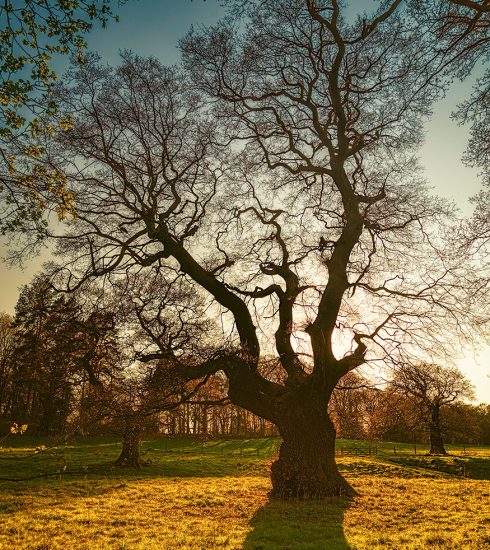
The Tree We Eat From Every Day


An Ancient Story About the Voice in Our Heads
Today, like every day, you woke up.
And almost immediately, the commentary began.
“Oh, no. I’m still so tired. I didn’t sleep well. Why does my watch say I got a 98 sleep score? My shoulder hurts. Did I sleep in a weird position? I wonder if I have time to sleep in…”

For most of us, this voice doesn’t stop until we go to bed at night.
Or, if we’re lucky, we get so intoxicated that we sink into a comatose respite for a few unconscious hours.
Is this what it means to be human? The cashier at CVS woke up evaluating the quality of his sleep. The person who served you lunch contemplated whether starting a lobster food truck was the right career move. Your manager at work spends more time evaluating herself than she does you.
What’s remarkable isn’t that we have these thoughts. It’s how seamlessly they become our experience of life. Between us and nearly everything we encounter sits an almost continuous stream of interpretation: evaluating, comparing, approving, condemning, predicting, remembering.
It made me wonder: how often am I actually meeting life directly? And how often am I meeting my thoughts about life?
And is there a difference?
Maybe this incessant stream of commentary is simply what it means to be human. René Descartes famously concluded, “I think, therefore I am.” And I’ve always found that fascinating because, while it’s difficult to deny that I think, it has become increasingly difficult for me to believe that my thinking is the most fundamental thing about me.
After some reflection, I’ve come to realize that there are moments in life when the internal commentary seems to disappear.
Petting your dog. Watching your child laugh. Taking in a sunset. Skiing down a mountain. Listening to a song. Being completely absorbed in conversation.
What’s curious is that when we remember those moments later, we usually say we felt most alive. Why do these moments feel so different?
This is why I keep returning to one of the oldest stories humanity has ever told.
The Tree
You know the story. In the beginning there was Eden, where Adam and Eve wandered around naked as the day God made them. They had no reason to feel ashamed. The Garden was all they knew, and all they needed.
There was a particular vegetation called the Tree of the Knowledge of Good and Evil. God was very clear: “Don’t eat from this tree or you’ll die.” I’m paraphrasing.
Adam and Eve had no problem with that, and why would they? Eden was paradise. They were all good. Until along came the Serpent, tempting Eve with this fruit of forbidden knowledge.
Eve ate it. She brought it to Adam. He ate it. They chewed in silence.
Immediately, their eyes were “opened.” Not in the glowing enlightenment sense, but in the way your eyes open when you suddenly notice you’re naked on a Zoom call. The Tree’s knowledge came flooding in, powerful and exacting.
The story continues: they were banished from the Garden. For most, the moral of the story is the consequences of disobedience. I wonder, though, if the “Fall” contains a deeper message.
The part that has struck me as odd is the name of the tree. Why this tree? It seems very specific. Not the tree of sin, or the tree of evil, but the Tree of Knowledge of Good and Evil. It does sound tempting. After all, who wouldn’t want more knowledge?
Though what is knowledge of good and evil? At face value, it seems harmless: knowing that some things are good and some are bad.
But what does it look like to use knowledge of good and evil after never having needed it?
We know from experience that eventually “good and bad” become “right and wrong,” “lack and enough,” or “like and dislike.” Suddenly, everything becomes content to be categorized, evaluated, and compared.
That alone may sound benign, even useful. But the seed of this fruit bears an entire conceptual world.
Now, for Adam and Eve, what was once simply a flower provokes comparison: “That flower looks worse than the others.”
Once we compare, we begin to prefer.
“I wish that flower looked like the others.”
Once we prefer, our preferences coalesce around an identity.
“If that flower I planted doesn’t blossom, I’ll become a failure.”
And suddenly, Adam’s garden looking better than mine isn’t merely a horticultural observation. It means something about me.
Perhaps the “Fall” from Eden wasn’t a punishment at all, but the natural consequence of acquiring such knowledge.
From here, the story takes on a different meaning. The fruit doesn’t symbolize forbidden information; it represents the birth of the narrator. The inception of the conceptual world in which our personal stories play out.
I’m using narrator loosely here: not just for the literal voice in our heads, but for the mind’s near-constant tendency to interpret, evaluate, remember, predict, and explain.

The Narrator
I began to wonder how this relates to my own life. I undoubtedly have an internal stream of commentary that remarks on almost everything. It’s so normal, I never thought to question it. And when I do try to examine it, it’s almost unbearable.
Am I too banished from the Garden of Eden?
A beautiful bird lands on my windowsill, just long enough for me to admire it. Soon enough, my mind starts categorizing: “It has an orange underbelly. I wonder if that’s an American robin.”
Or sometimes I’ll be engaged in something that’s really enjoyable. I’m totally in the moment, and then my mind jumps in to say, “I should do this more.” Sure, but I’m doing it now. Plans can wait.
It would be one thing if the commentary enhanced the moment, but usually it’s useless narration that pops in the same way my Aunt Fran compulsively interjects with her seemingly indispensable opinion.
I don’t mean to drag my Aunt Fran through the mud. I’m just wondering if my mind’s continuous stream of commentary is somehow distancing me from my actual life, and if that distance is keeping me from a more intimate experience of it.
Although I have to admit: the thought of encountering reality without this familiar voiceover makes me feel naked. Like I’m raw-dogging life without protection. I think a lot of us come to rely on this conceptual veil like a security blanket, keeping us safe from the parts of life that hurt when we really feel them.
Because, let’s be real, there are parts of life that are unpleasant. If I stub my toe, it hurts whether or not I’m narrating the experience. If a relationship ends, the grief is real.
But I’ve started to notice a difference between experiencing something painful and experiencing everything my mind has to say about it. There is sadness, and then there is, “I shouldn’t still be this sad.” There is fear, and then there is, “Why am I like this? What if I always feel this way?” There is rejection, and then there is the elaborate case my mind builds for why this rejection proves something about who I am.
The first is part of being alive. The second is me taking another bite.
What if I haven’t lost paradise? What if I’ve simply become so identified with the narrator that I no longer notice it?
The Tree and the Garden
If I’m inadvertently giving you the impression that thinking itself is the enemy, I’ve misguided you.
The narrator is incredibly useful. It allows us to remember, plan, solve problems, tell stories, and figure out the end of a movie before the climactic reveal. Our ability to think has helped us create language, technology, and entire civilizations.
The narrator isn’t the problem. In fact, it’s miraculous. But maybe because of its tremendous gifts, or simply because it’s been with us for as long as we can remember, we easily mistake the world it constructs for reality itself.
If the narrator is both miraculous and limiting, how do we reconcile that?
Perhaps we don’t have to choose between the Tree and the Garden. We can use the narrator when it serves us without getting lost in it. I can think about the mountain when I want to know its elevation and simply admire it when I don’t. I can reflect on a conversation when reflection is useful and recognize when I’ve crossed over into replaying it for the fifteenth time.
The freedom isn’t in eliminating thought; it’s in no longer being entirely at its mercy.
More Than Enough
I remember one afternoon, I had been immersed in and overwhelmed by all the work I had to do. My mind was in overdrive with no signs of slowing down. I sat on the couch to mentally chew over every last detail, but then my dog jumped up and put her gentle head in my lap.
Suddenly, I wasn’t thinking about why my last YouTube video got only 19 views. I was entirely captured by the softness of her furry ear on my knee.
My worries evaporated without a trace. In that moment, my entire world was just me and Dreidel. And that was more than enough.
Maybe the Garden isn’t somewhere we return to. Maybe it’s always been where reality simply is, before we decide what to make of it. The birds still sing. The mountains still stand. Coffee still smells like coffee. Children still laugh. Life continues to unfold despite what the narrator says.
The narrator doesn’t create reality. It narrates reality. Somewhere along the way, we forgot the difference.
I still eat from the tree every day. I doubt that’s going to change. But every now and then, I notice I’m chewing. The Garden hasn’t returned, because it was never gone. I’d simply become too preoccupied with the voice describing it to notice where I was standing.
TAKE ACTION: Today, notice one moment when your mind begins evaluating something you enjoy, such as the taste of your coffee, a song, or time with your pet. Gently return your attention to the experience itself. You don’t need to silence the commentary; simply notice what else is here. If you’d like to explore a different relationship with the voice in your head, discover Dr. Evan Fishman’s work and resources.