Why Everything Is Falling Apart (and It’s a Good Thing) – An Interview with Neil Gaur
What if the chaos we’re witnessing in the world isn’t a sign of collapse—but a doorway to collective awakening?
For Neil Gaur, the journey into consciousness wasn’t sparked by a single mystical moment, but by decades of inquiry into ancient civilizations, cycles of time, science, and the nature of darkness itself. From studying Sumerian creation myths and global flood narratives to founding Portal to Ascension and stewarding one of the longest-running consciousness expos, Neil’s path has been shaped by an unwavering devotion to truth, integration, and evolution.
In this wide-ranging conversation, Neil explores why humanity is undergoing a profound ego death, how darkness serves as a catalyst for growth rather than something to be feared, and why integrating science, spirituality, and embodied practice is essential for what comes next. He also shares the inner and outer challenges of building a heart-centered movement in a changing world—and what gives him the most hope for humanity’s future. Continue reading or listen in by subscribing for free on Spotify, Apple Podcasts, Amazon Music, or YouTube to discover how Neil Gaur’s insights invite us to meet this moment with courage, compassion, and clarity.

Before we dive into your own journey—which I’m excited to hear about—I want to hear your perspective on what you sense is unfolding in our world right now. There are so many good things happening, of course, but then you turn on the news or scroll through The New York Times, and it’s like… what is going on? So I’m asking you: what’s happening right now?
Neil Gaur: It’s a good opening question, because it’s actually something I often lead with in conversations myself—what is really happening right now? From my perspective, it’s all good. Even the bad is part of the good. That’s my personal take.
What’s happening is a shift in consciousness. People are waking up. There have been control tactics and agendas that have played out in the world, but when you really look at the aftermath, many people have woken up through these situations. Everything they do—whoever “they” are—backfires. It’s almost as if the darkness and the chaos being created are actually acting as a catalyst for our growth.
In a world of amnesia, where we don’t remember past life incarnations or our connections to other planets and so much more, the best way to understand who and what you truly are is to experience the polar opposite. I’m going to butcher the quote, but when the light gets brighter, the shadow gets bigger. There’s a polarity to it all.
What’s happening right now is that we’re not able to take our baggage with us. Back in ancient Egypt, they would place gold and tools in tombs, but you could never take those things into the afterlife. Similarly, it’s like we’re dying without physically dying. We’re having an ego death. We’re going through a rebirth—a resurrection—while still in our physical bodies. But we’re not allowed to take our emotional or traumatic baggage with us.
That baggage has to come to the surface to be dealt with. It’s almost like we’re at the event horizon of a black hole, about to move into the fifth dimension, and the only way through is for all the impurities to be pulled out of us. That’s why we’re seeing so much chaos and craziness in the world. All the old systems—based on victim mentality, lack, trauma, and fear—need to crumble.
Entire institutions have been built on fear and scarcity. We could do a whole podcast just on that. These systems have been around for thousands of years, and many people have deeply identified with them. So when they begin to shift, and you’re suddenly moving into the unknown, into mystery, it naturally brings up fear and insecurity. It can make you feel unstable, unsure of what’s coming next.
To me, these are necessary growing pains. When you zoom out and look at the bigger picture, you can see that these institutions don’t actually serve the masses. And the masses are getting to a point where they’re sick and tired of being sick and tired. That’s really how I see it.
Some people are aware of these shifts and are processing them—listening to podcasts, having conversations in community—but others are just trying to cope. They’re just trying to make it through the day and asking, “What is going on?” What would you say to someone like that—someone who might not be aware of the systemic issues you’re describing and is just trying to put food on the table?
Neil Gaur: When it comes to putting food on the table and providing for your family, I can’t really speak to individual situations. The struggle is real. Unfortunately, we’ve created a world based on scarcity and lack, even though we live in an abundant universe.
From an esoteric or metaphysical perspective, the universe is abundant. But for people who aren’t aware of that, they’re living within systems designed to create scarcity. And once scarcity exists, it becomes about someone else taking something from you. That’s how the divide-and-conquer mentality works, and that’s how control is maintained.
When you believe there’s another person, another country, or another leader trying to take away your sovereignty or your ability to survive, you live in fear. And when you’re in fear, you’re more easily aligned with whatever narrative is being presented to you. I understand that—it’s a self-protection mechanism.
At the same time, people still need to work, earn income, and take care of their families. That’s the reality. But what I really feel is coming in the near future—through many different developments, including AI, quantum computing, UFO disclosure, and reverse-engineered technologies that have existed behind closed doors—is a shift toward having the technology, awareness, and capacity to live in peace and harmony.
Right now, it’s harder because those who want to maintain control and power don’t want these things to come forward. So what can someone do in the meantime? For me, it comes down to not avoiding or suppressing your feelings. Don’t distract yourself from it. Try to find inner peace in the midst of chaos.
That’s why I always say feeling is healing. What do people often do when they’re just trying to survive day by day? They distract themselves. They disconnect. They work nonstop, and when they finally stop working, they numb out in front of the TV to escape the pain.
The only thing I can really recommend is allowing yourself to feel—whether that’s sadness, grief, or depression—and actually accepting and embracing all parts of yourself. Rather than chasing constant dopamine hits just to stay “happy,” allow yourself to be present with what’s really there.
It’s a hard thing to explain, honestly. I can’t offer simple solutions to someone who has kids at home and is making half of what they need to survive. In that case, the answer really is a metaphysical one: Why do we come here? Why do we experience this? And how do we move toward changing it in a way that works for everyone—not just a few?
I love the connection between the metaphysical answer and a more somatic approach to healing. It feels like those two go hand in hand. You can understand the dynamics of the universe, but if you don’t have tools for self-regulation, it stays at an intellectual level. And if you only have the tools but don’t understand the larger system, you’re left asking, “What’s the meaning of all of this?” So I really love how those worlds come together.
Neil Gaur: What are two—or really three—of the biggest issues in the U.S.? Obesity, heart disease, and depression. Some of the highest rates in the entire world. And how do you get to that point? You’re eating your feelings. You’re deeply depressed—chronic depression.
There was even a study released about a year ago showing that a low-level, chronic depression now exists for a majority of men in the U.S., largely because of loneliness and disconnection. When you don’t take a holistic approach to life and start distracting yourself from your inner experience, it creates a downward spiral.
If you start feeling what’s there, you can at least maintain equilibrium. But the more you disconnect from your feelings and sensations—what’s actually happening within you and in the world—the deeper that spiral goes. And at some point, you’re so far down that you don’t know how to climb back out.
What’s fascinating is that this is the microcosm of the macrocosm. This is exactly what we’ve done collectively as souls on Earth. We went so far down into the spiral that even though many of us are waking up now, the darkness feels incredibly intense. The darkness within us—which is really just a wounded child—doesn’t recognize itself in the light anymore. It doesn’t know how to emerge.
That’s something we’re all going through individually, but it’s also happening collectively.

I do want to dive into your own awakening journey. Maybe we could start with your upbringing and family life. Was consciousness or spirituality part of that, or did it come later for you?
Neil Gaur: Not spirituality on the level we’re talking about now, or what I’m involved in professionally. But I was raised Hindu. A lot of people assume that because of that, I must have been very spiritual. But honestly, Hinduism can be one of the most blind-faith religions in the world.
That’s not unique to Hinduism—it happened to all religions as we entered a lower age. Religion became ritualistic. When we forgot our direct connection to Source, to God, we created rituals and contractual relationships with the divine. If I do this, you give me that. If I go to church every Sunday, I’m a better person. If I chant this mantra or fast on a certain day, my family will be protected, or my son won’t have a car accident.
I experienced a lot of that growing up. Even though there are many deep truths in Hindu philosophy—and so much of modern spirituality, even the hippie movement, came out of ancient Vedic teachings—I never really felt connected. I would go to a temple, called a mandir in Hindi, but it was more of a place to see friends and be part of the community.
I grew up in England, and every week my grandfather held a religious ceremony at home called a havan, where we’d sit around a fire and sing hymns in Sanskrit. I didn’t even know what the words meant. We were just kids singing songs, and everyone thought it was cute. But I didn’t think much about God, even though religion was a huge part of my life.
Later, when I moved to the U.S., it continued. And at some point, I became curious about the fact that we celebrated Christmas my whole life. Most Indians—especially first-generation families in England—celebrate Christmas. We celebrated it fully. I watched The King of Kings every year, the Moses movies—I knew a lot about Christianity.
When I was around sixteen or seventeen, I started noticing similarities between Christianity and Hinduism. But earlier, when I was eleven or twelve, I had attended a Catholic school in England. My parents sent me there because I was getting into trouble with the Indian kids, and they thought hanging out with white kids would be better for me, which is ironic, because in the U.S., they wanted me around Indian kids.
At that school, the priest told us that Hinduism and Christianity evolved separately, in completely different parts of the world, with nothing in common. As a kid, I believed that. I thought there was no connection between polytheism and monotheism.
Then I came across stories of Krishna and discovered all these parallels—being born of a virgin mother and having a carpenter for a father. And Krishna even said, “I am the way and the light.” I thought, wait—that’s what Jesus said.
My first conclusion at seventeen was that Christianity borrowed these stories from India, and that Jesus never existed. That was my first awakening moment. I don’t believe that now, but at the time, that’s where I landed.
So I kept searching. I realized these traditions weren’t separate—there was a connection. That led me to ask if there was a root to all religion. If you go far back enough, maybe everything is connected. Even if Adam and Eve aren’t literally true, there must have been fewer humans at one point. Maybe one original tribe. And all religions stem from that.
That search eventually led me to the Sumerian tablets of creation. I was eighteen years old. It was the year 2000. And that was the beginning of everything for me.
Wow. And once you found that resource—those documents—what did that open up inside of you?
Neil Gaur: The next chapter really began there. There were seven tablets of creation—seven tablets, seven days of the week. All of that comes from there. The Elohim, the Yahweh stories—all of it traces back to those texts.
The first thing I encountered was The Epic of Gilgamesh. It’s the story of a hybrid being—half god, half human—living on Earth within a civilization. Gilgamesh travels across the planet and eventually meets a man and his family living on a mountain. The man tells him, “We are the last survivors of a great flood.”
That’s when I realized—this is the original Noah story. Noah’s name appears differently in the Sumerian tablets, but the story predates the biblical version. That opened something huge for me. I started asking, wait—the flood story isn’t just biblical. It exists in Sumerian texts, too.
So I started looking deeper. I found dozens of ancient texts from different civilizations, all describing a great flood. That’s when it clicked for me: this wasn’t a myth. This was a collective trauma experienced by humanity. Every civilization remembered it.
You can even trace it back to around 11,900 years ago—the end of the last Ice Age—coinciding with what appears to be an asteroid impact. Suddenly, the flood story felt very real. There was truth embedded in it.
Another detail stood out to me. In the Bible, Noah is portrayed as the last human on Earth with his family. But in the Sumerian texts, Gilgamesh comes from another civilization and meets Noah. That means other humans were still alive. Noah wasn’t the last human—he was the last of his species. Multiple types of sentient humans were coexisting on the planet at the same time.
Once I realized that, I went completely down the rabbit hole. And it just kept unfolding from there.

As you were learning all of this and asking these questions, were you keeping it to yourself, or were you talking with your family and friends about it? How did people respond?
Neil Gaur: I wasn’t really talking to my family about it—not because I was hiding anything, it just never came up. I had just started college at Cal State Fullerton, and I’d be sitting at places like Panera Bread reading this material. Around that time, I made a close friend who was also into these topics, and we would exchange information.
I didn’t really have a strong community around it until about five or six years later, around 2007. Back then, everything was online. Facebook had just launched—or was about to—and I started connecting with people from all over the world who were exploring similar ideas.
My community was mostly online, but I was so passionate that I talked about it everywhere. I’d be at a bar after college and telling people about the ninth planet, about extraterrestrials seeding humanity—anyone who would listen. Everyone except my family.
I had a difficult time communicating with my parents back then, especially my father. We loved each other, we had dinner together, but there wasn’t much real conversation. It was mostly silent. So when I was out in the world, I was always bringing these topics up with people.
I love that. So then in 2008, you started what you call Portal to Ascension. What was happening in your life at that time? What was the vision that was beginning to form?
Neil Gaur: It actually started around 2006. I had been deep in the rabbit hole for years, but I was very focused on conspiracy theories at that point. Even though everything I was learning was spiritual, I hadn’t yet embodied it. I was intellectualizing instead of integrating.
I believed that bloodlines controlled humanity, that negative extraterrestrials had taken over governments. At the same time, I strongly believed in the 2012 consciousness shift. So in 2006, I created a Facebook group called 2012 Consciousness, Mind Evolution, and Presence. It was a big name.
People started joining—first hundreds, then thousands. That’s when my community really began to grow. Over the years, I connected with around 10,000 people worldwide through those groups, learning from one another and sharing information.
Then 2008 happened. The market crashed, and I was working as an assistant to a financial analyst in Laguna Beach. Right after the crash, I made a trade that lost a significant amount of money, and I got fired.
So there I was—out of a job—and I asked myself, what do I really want to do? I decided to learn web design and started building a website. Around the same time, I was performing spoken-word poetry at open mics in Costa Mesa. The Gypsy Den was my spot.
I loved that place.
Neil Gaur: I loved it too. I was there a lot. But I was in a pretty low place emotionally. One night, a guy got on stage and sang a song called My Name Is Love. And something shifted in me.
Up until then, I had learned so much—but I was angry. Angry at the people I believed had lied to us. Angry at those I thought controlled the world. And in that moment, something changed. I stopped seeing things as happening to us and began seeing them as happening for us.
Instead of feeling anger toward those I perceived as ignorant or controlling, I began feeling gratitude—for providing the experience of darkness, which creates the contrast needed for evolution. That was a major turning point for me.
A couple of weeks later, I had a dream. In the dream, I was told to change the name of my online group to Portal to Ascension. I contacted Facebook, changed the name of my fan page, and that’s how it was born.
The first Portal to Ascension event took place in Costa Mesa in August 2008.

And why did you start with an event? Out of all the things you could have done, what was it about creating an event that really intrigued you?
Neil Gaur: It’s interesting—I never really questioned it at the time. But looking back, there wasn’t podcasting the way there is now. There wasn’t YouTube, or people becoming “YouTube famous.” Back then, it was mostly workshops and in-person gatherings.
One of the main reasons was a place in Costa Mesa called Ginger’s Garden. I had been attending holistic events there—Kundalini yoga, energy healing, and so on. I became good friends with Ginger, the owner, and her kids. The space had a downstairs area with chiropractors, Rolfers, Reiki practitioners, and then an upstairs room that could hold about a hundred people.
Since I was already spending time there and attending events, I asked her if I could experiment with creating my own events upstairs. She said yes—and she didn’t charge me rent for almost two years. That gave me so much freedom to experiment.
I tried all kinds of things. I hosted sound healing trainings. My very first event was called Hypno Creativity—it combined hypnosis and binaural beats to help people release creative blocks and express themselves more fully. A friend of mine was the hypnotherapist, so we collaborated on that.
Then I suggested doing psychic fairs. We hosted monthly fairs in the parking lot for about a year—about 20 vendors each time—with ongoing meditation and energy-work workshops upstairs. That became my playground. I was learning by doing.
Around that time, someone who goes by the name Dr. Dream—Mark Ler—was also hosting events there. He led something called Unconditional Love Gala Activations. He used a Rife frequency machine that people connected to while he played instruments and worked with 20 different modalities at once. We became good friends.
A few months later, I called him one day, feeling completely burnt out from my new job as a web designer. He said, “Quit your job. Move into my house. Book a tour for me. Let’s go on the road up and down the coast for the next year.”
And that’s exactly what I did.
Over the last seventeen years, what metamorphoses have you experienced—intellectually, spiritually, even from a business perspective? What shifts and changes have unfolded for you along the way?
Neil Gaur: One major shift has been my understanding of cycles of time. I wasn’t aware before that humanity has gone through repeated cycles of evolution, remembrance, and forgetfulness. I used to think there was just one cycle—from Atlantis to now. But I now believe this has happened many times.
What’s changed is my belief that we’re finally breaking free from that cycle. You could call it a karmic or self-imposed cycle, but ultimately, these cycles are connected to our solar system’s position in the galaxy. This isn’t just a metaphysical metaphor—you can literally track the trajectory of our solar system as it moves through the Milky Way.
Our solar system dives into the photon belt and then emerges on the other side. The Earth oscillates about 200 light-years above and below the galactic disk. So my understanding of ascension has become more scientific. What used to feel purely metaphysical, I now see reflected in the physical universe—and even in our own bodies.
Another major shift has been my understanding of the chakra system. I used to think of chakras purely as metaphysical energy portals. But when I began studying physiology and the nervous system, things clicked in a new way.
Our brain sends an electrical current down the spinal cord, distributing energy to all of our organs—much like a battery. When that current stops, life stops. What’s fascinating is that at each point along the spine where a chakra is said to exist, there is an actual opening where nerves branch out to specific organs. These openings are called neural foramina.
The frequencies associated with chakras and Tibetan singing bowls correspond to the electrical currents flowing through those regions. That realization was mind-blowing for me. It showed that chakras aren’t just symbolic—they’re part of a real, biological system. Trauma, physical misalignment, or blockages can disrupt that electrical flow, affecting both frequency and organ function. Those are just two examples of how my understanding has evolved scientifically.
On a more personal and spiritual level, one of the biggest shifts has been my relationship with darkness. For a long time, I carried a lot of anger. Even after my awakening in 2008, I still felt like I was fighting against something.
Now I understand darkness differently. I don’t see it as evil. I see it as a fractalized aspect of Source—one that has gone so deep into duality and density that it no longer recognizes itself as Source. This realization has really crystallized for me only in the last year.
A lot of people say, “Go to the light—we are all light.” But that language doesn’t fully resonate with me. In the beginning, everything was frequency. If you look at the Old Testament or dozens—actually hundreds—of creation stories, none of them say light came first. They all say sound came first. Sound accelerated into light. Slow it down, and it becomes darkness. Everything is frequency.
When singularity—the oneness—became duality, and duality eventually became light and dark, do we really believe that Source loved one aspect of itself more than the other? Or did it love both equally? And if that’s true, could it be that Source loves the darkness just as much—maybe even more—because it represents the most extreme experience of separation?
Darkness doesn’t mean evil. It means the unknown. The hidden. Light reveals what darkness holds. As darkness condensed, it took on density, becoming the feminine—the black light. This is why the universe is feminine, and the sun is masculine, why black holes receive energy like a womb, while stars radiate outward.
As density increased, free will emerged. And with free will came judgment. That’s when darkness became labeled as evil. But that’s a human overlay.
I’ll share a meditation experience that clarified this for me. I was on a ten-day silent meditation retreat last year. I had heard people say that even a small light makes darkness disappear. During one meditation, after days of sitting in inner darkness, I saw someone enter a room in my mind and turn on a light. Instead of disappearing, the darkness condensed into the form of a frightened child, trembling in the corner.
That’s when I realized—darkness isn’t running from the light. It’s a wounded child that has been so separated from the light that it no longer recognizes itself in it.
This understanding has deeply shaped Portal to Ascension over the past few years. For example, I’ve done a three-part series on what people call “reptilian energy,” exploring it not as evil but as consciousness traumatized and fragmented.
This perspective also mirrors what we see politically and socially. We project evil onto “the other side.” We stop seeing ourselves in one another. Unity consciousness can only happen when we recognize ourselves in the other.
That’s what happened between light and dark—they stopped recognizing themselves as one. And what’s happening now, through this ascension process, is the reunification of both. Not just the light is ascending—all of us are, including our dark parts.
You’ve given us a masterclass on darkness. This is so good—thank you for sharing all of that. What really stands out to me is how each of these breakthroughs has implications not just for your thinking, but also for how you live: how you treat people, how you engage with culture, the environment, and relationships.
You’re embodying something really important in this conversation—you’re still a seeker. You’re still seeking wisdom and transformation, even though it’s been seventeen years of developing Portal to Ascension into what is now, for lack of a better word, a significant business. You’ve mentioned doing more than seventy events a year, many online and many in person.
How have you remained a seeker rather than letting this turn into “just a business”? How have you stayed a passionate seeker?
Neil Gaur: I was taking notes as you were speaking because there are a few things I really want to touch on.
First and foremost, maintaining heart and approachability has been essential for me. My email list and network are pretty extensive, and I send out a message simply titled Mission two or three times a year. It comes straight from my heart—what’s happening in my life, how I’m reflecting on it, and how it mirrors what’s happening collectively. I send another one at the end of the year—this year it’s called Reflections on 2025 and Looking Toward 2026.
That kind of heart coherence and connection is really important to me. People often tell me that when they attend my events—especially online—it feels like a group of friends sitting around a fireplace, just having a conversation. At the same time, I’ve had to balance that warmth with professionalism.
Early on, some of my biggest challenges were actually things that slowed my growth—but in hindsight, they were lessons I needed. One of them was listening too much to other people’s opinions about how I should run my business, instead of trusting my own inner compass. I was constantly people-pleasing.
Sometimes I was fully booked for an entire year, and someone would ask me to be part of an event. I didn’t want to say no, so I’d squeeze it in—even when I knew it probably wouldn’t be successful. That meant fewer resources for events that would succeed, less income, and more stress trying to keep Portal to Ascension afloat.
Another example was pricing. For years, I charged $33 for events. I can’t even tell you how many messages I received calling me Illuminati because of that number. That went on for about six years before it finally stopped.
There were other things too. I don’t choose speakers based on race—I choose based on quality, integrity, and my experience with them. But if an event happened to feature only white speakers, I’d get accused of being racist. That, too, eventually stopped as my vibration shifted.
I’m sharing all of this because, for a long time, I was abandoning my own inner compass to appease external voices. I was constantly questioning myself—Am I doing this wrong? Should I bring in different people? Am I missing something? It was like a scared kid trying to please a father figure, wanting approval from some external authority that didn’t even exist. That dynamic traced back to my relationship with my own father.
I used to say my niche was “everyone.” When people asked about my demographic, I’d say that because I wanted to be radically inclusive. But in business, that doesn’t work. Not defining a niche actually hurt me—it prevented clarity and sustainability.
What’s changed is that I’ve immersed myself in understanding business more deeply, learning from people who have built long-lasting, successful organizations. Now, when I’m making decisions, I ask myself a simple question: If I want this business to still be thriving in twenty years, what decision would I make right now?
That question has changed everything—who I work with, who I keep on my team, and how I set boundaries. I’ve experienced real abuse from people I employed simply because I didn’t know how to say no or have hard conversations. Now, if someone continues to act in a way that’s misaligned, I’m willing to say, “Maybe it’s best that we don’t work together.”
Another realization was about self-worth. I didn’t fully grasp how big Portal to Ascension had become, or that people wanted access to it for their own visibility. I would say yes out of a need for approval, without seeing how those choices affected my bottom line or my ability to sustain the platform. That led to a lot of ups and downs.
One more key insight came from understanding the difference between managers and makers. Managers succeed by moving from meeting to meeting—they delegate. Makers are the creators: designers, editors, builders. I realized that when my week was filled with scattered meetings, I never had the mental space to create. Even if I had two free hours between meetings, my nervous system was already anticipating the next interruption.
So I changed my structure. Now I schedule all meetings within two or three days—usually Monday through Wednesday. The rest of the week, through Sunday, is reserved for making and creating. That shift alone has allowed me to go deeper into my work and be far more effective and sustainable.
That balance—between heart, discernment, structure, and long-term vision—is what’s allowed me to remain a seeker while still growing a business.

Thank you for sharing all of that. Fascinating. It sounds like—whether intentionally or unintentionally—you’ve sustained your relationship with Portal to Ascension because you’re a passionate seeker at heart, and only now is the business taking up more of your focus.
Neil Gaur: Yes.
Whereas it seems like others may jump into the business side more quickly, and over time, it kind of pulls the seeker out of them.
Neil Gaur: Yeah, exactly. And the reason I’m even sharing very concrete, almost business–seminar–level tools now is that I’ve taken on the New Living Expo, over 3,000 people. I already had more than a full-time schedule, and now I’m essentially working full-time shifts on top of that.
It’s a huge responsibility. So many people are relying on me—the exhibitors, the speakers, the attendees. They’re investing in the vision I’m creating, and they’re trusting that what I’m building will support their success. And that’s just one expo. On top of that, there are other events, the England conference, the cruises—a lot is happening.
The more responsibility I take on, the more I realize I don’t have time for distractions. I don’t have time for anything that drains my energy. I need focus and discipline. So even though externally I’m doing more than ever, internally I’ve had to create very strong structures.
For example, I don’t touch my phone for the first hour of the day. I have a one-hour limit on Instagram. I can’t open any apps—except Uber—until 9:30 in the morning. Everything is blocked.
And what do you do with that time?
Neil Gaur: I meditate. I go to the gym. And that’s another big realization—the solutions aren’t always as “spiritual” as people think. They’re often very physical.
About two years ago—really one year ago intensely—I started working out consistently. I had gone through a divorce four years ago, and a lot happened after that. I had tried everything: Reiki, energy work, hypnotherapy. And I realized the one thing I hadn’t really tried was going to the gym, getting a trainer, and moving the energy physically.
So now, because I protect that morning time, I focus on physical practices. I don’t really watch spiritual YouTube content anymore because I’m immersed in that world through the events I create. Instead, in the mornings, I listen to a handful of business leaders who are deeply spiritual but also highly successful—multimillionaires who are actually living in both worlds.
I study how they think, how they focus, how they structure their mindset. That first hour is about feeding myself with exactly what I want to cultivate and create in my life.
Who are some of the people you’re following right now—those voices you’re finding inspiring?
Neil Gaur: Alex Hormozi and his wife, Leila Hormozi. Alex is very tactical—how to grow, build, and scale—but Leila is incredible when it comes to mindset and inner shifts that drive success.
Another big one for me is The Diary of a CEO with Steven Bartlett. That’s probably my favorite podcast. What I love is that these people are far more spiritual than they may appear on the surface. Steven just had Lue Elizondo from the UFO program on the show.
So I’m getting a little bit of everything—business, consciousness, discipline, and expanded perspective—all at once.
I’m curious about the New Living Expo. You recently brought it into the Portal to Ascension family, and it’s a well-known event in the Bay Area here in the U.S. I’m curious why you decided to purchase it rather than collaborate or partner in some other way. And I’m also curious about the vision you’re bringing to the Expo—what feels essential for you to preserve, and what feels ready to evolve?
Neil Gaur: Yeah. I was there back in April as a speaker, and as I was leaving, my friend Deborah—who’s been involved since the very beginning, helping with promotion—was walking to her car, so I walked with her. She casually mentioned, “Did you know that Ken, the former owner, is selling the Expo?”
My immediate reaction was, I want to buy it. And part of me laughed, because I’ve always been ambitious—sometimes to a fault. But honestly, Portal to Ascension was built on being all in. There have been countless moments where I risked everything and put everything I had into it. That same ambition is also why it’s become what it is.
At first, I said it half-jokingly, but she encouraged me to reach out to Ken. So we started talking. Over a few months, we went back and forth—reviewing the P&Ls, the history, everything you’d expect. And throughout all of that, there was just this strong internal knowing.
The reason I immediately thought of purchasing it—rather than just helping or collaborating—is because I’m one hundred percent certain the world is not going to look the same three to five years from now. Between AI, quantum computing, universal basic income becoming a global conversation, UFO disclosure, intelligence officials saying that if governments don’t speak up by 2027, extraterrestrials will—everything is accelerating.
So when I saw the opportunity to steward an event with an established legacy and carry it into the future, it felt completely aligned with what I’ve always been about. I think part of that might also be because I’m a millennial—I’ve lived in both worlds. I understand the old paradigm deeply, but I’m also fully oriented toward the future.
What I’ve noticed at many expos is that many websites, graphics, and even speaker lineups still reflect an old paradigm. And that’s often why those events struggle—they’re holding onto something that no longer resonates. New Living Expo began as the Whole Life Expo in the 1970s and evolved into New Living Expo, but it retained a lot of that guru-era energy.
While that movement was important, the collective has shifted. People are now deeply interested in topics such as extraterrestrial intelligence, quantum physics, the science of consciousness, somatic practices, breathwork, and embodied healing. Even though New Living Expo had elements of that, I’d say 80–90% of the programming still reflected an older self-help paradigm.
For years, my vision with Portal to Ascension has been to scale—to bring deeper esoteric wisdom together with grounded, embodied practices. So rather than building something entirely new, this felt like an opportunity to evolve something that already had recognition and trust.
There was also a very personal connection for me. Ten years ago, I was a vendor at New Living Expo, selling Tibetan singing bowls. From around 2009 to 2011, that’s actually how Portal to Ascension sustained itself—traveling to the Conscious Life Expo and the New Living Expo, and selling bowls to fund the work. So there’s a deep historical tie.
I also knew Ken personally and understood the heart behind what he had built. It felt like the perfect moment to help this event take its next evolutionary step.
What I’m envisioning now is New Living Expo as part of the future of conscious gatherings. I don’t even fully know yet what that means—but I know it involves embracing what’s coming rather than resisting it. Using new paradigms and technologies in the service of consciousness, rather than fearing them.
One more piece that’s really important to me is history and storytelling. The Bay Area—and places like Laguna Beach—were two of the most influential regions for consciousness movements in the 1960s and ’70s. So much of what we now call “New Age” or modern spirituality emerged from those areas, especially through the hippie movement.
This Expo is a direct descendant of that lineage. It carried that awareness forward, but over time it began to fade. To step in at this moment and help resurrect it—right where it was born—felt incredibly meaningful to me.
And California is still home for me. Even though it’s expensive and challenging to host events there, I feel a strong responsibility to maintain a presence. That’s why my two main conferences are in England—where I was born—and in California—where so much of my journey unfolded.
All of that combined is why I said yes.

Are there elements of New Living Expo where you’ve said, “We don’t want to change this—this is the essence”? Beyond the history, are there parts you feel are essential to preserve?
Neil Gaur: Yes. One of the core elements is the expo model itself—multiple rooms running simultaneously. Six to eight rooms at a time. That structure works, and we’re going to keep it. Ideally, we’ll grow it and expand attendance, but the framework stays the same.
We’re also maintaining how exhibitors participate and interact, along with many of the logistical systems that already function well. At the same time, there’s a three-year plan. And that plan is a gradual evolution of the branding. I don’t want to alienate people who’ve been attending for years by changing everything so abruptly that it no longer feels familiar.
We’re doing this for the same reasons, with the same heart. So we’ll keep that continuity—but over the next three years, the name and logo will change, and eventually it won’t be called New Living Expo anymore. We’ll likely involve the community in that process, maybe even take a vote.
More than anything, though, it’s the heart of the event that matters. New Living Expo has always had a strong, loving energy behind it. The producers have treated people beautifully, and attendees feel a deep affinity because they’ve felt respected and welcomed over the years. That’s something we’re absolutely committed to preserving.
Portal to Ascension is the same way—we want people to feel safe, heard, and genuinely cared for. At my last event in San Diego, after the conference ended, about 100 people were left. I was walking to my car, and a man stopped me and said, “I just want you to know—this is the first event like this I’ve ever been to, and I’ve never felt this safe in my life.”
That was the best testimonial I could ever receive—especially from someone who had felt unsafe his entire life. Creating a space where people can fully relax, be themselves, reset, and feel hope for the future—not false hope, but real hope that comes from coming together—that’s essential.
With everything you’ve researched over the last twenty years, what gives you the most hope for humanity right now? You said earlier that everything is good, that it’s all helping us. What gives you the most hope?
Neil Gaur: Some people might disagree with this, but there are a few things that really anchor my hope.
When you study cycles of time—ancient calendars that tracked consciousness—you can actually pinpoint where we are right now. Based on the dating given by the ancients, we’re at the point where consciousness turns upward again. I’ve spent countless hours researching this, cross-referencing it with science, and I’m fully convinced these cycles are real.
Within these cycles, there are windows—transition points—and if you look at history, those moments are always the most tumultuous times humanity has faced. But it’s also true that through great adversity comes great triumph. The greatest innovations always emerge after those periods. That gives me a lot of hope.
On a personal level, after hosting so many events and engaging directly with people, I can see that more and more people are waking up. They’re becoming less judgmental. This conversation about darkness is a perfect example. A few years ago, only a handful of speakers on my platform were saying what I shared earlier. Now, across the board, there’s a growing acceptance of polarity—within ourselves and collectively.
There used to be a strong New Age tendency to focus only on the “light” and reject the shadow. But now, people are being forced to witness and integrate both. Not everyone—there’s still a lot of anger out there—but more people are striving for non-judgment and inner stillness.
Almost every event I host ends with this question: How do you see yourself in the other? How do you love someone deeply even when they disagree with you? Buddha said that true awakening brings even greater compassion for those you disagree with than for those you agree with. That’s the direction I see people moving toward.
And then there’s the external reality. When it comes to the world at large, I truly believe the introduction of AI will catalyze humanity’s awakening in ways we can’t yet fully imagine.
Everything is inherently neutral. It’s our level of consciousness that determines how we use tools. But AI—without exaggeration—is one of the greatest inventions in human history. Its potential to assist humanity is enormous.
I ran a poll recently asking people how they feel about AI. Seventy-one percent said, “Proceeding with caution.” The next largest group said they were excited. That shows where the collective pulse is.
We could maintain the status quo—some people continue struggling, others remain comfortable—but that system doesn’t serve everyone. Sometimes disruption is necessary for humanity to recognize that the system itself needs to be reimagined.
AI, along with many other global shifts, is disrupting the trajectory we were on. And I believe that disruption is exactly what’s needed. What comes next—we’ll have to wait and see. But I genuinely believe it will be better than what we’ve known so far.
That’s a lot of hope. Yeah—it’s good. All right. Where can people find out more about Portal to Ascension and New Living Expo?
Neil Gaur: Sure. You can visit PortalToAscension.org—that’s my main website. Right on the homepage, you can sign up and get access to hundreds of hours of content just by joining the mailing list. There’s also an “Upcoming Events” tab with everything we have coming up.
We host a cruise, we do a conference every August in Glastonbury, and all updates go out through our email list.
As for New Living Expo, I really want to personally invite everyone to come. This event is going to be something truly beautiful and magical. Not only will there be incredible speakers, but it’s also located in a stunning part of California—lush nature all around, yet still close to the city.
It takes place in San Rafael, California, and the website is NewLivingExpo.com. I’d love to see you there if you’re able to come.
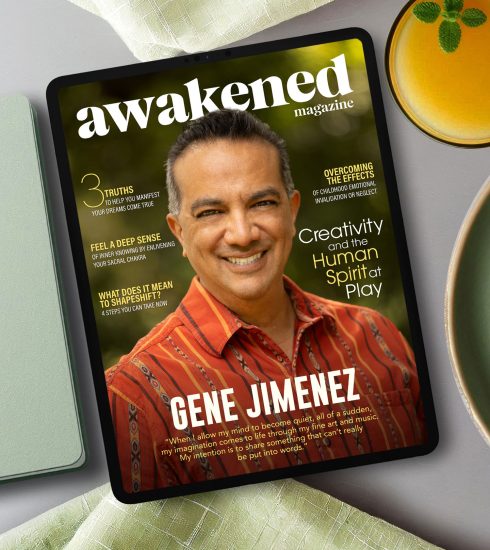
Wonderful. Mandy and I will be there—we’re really looking forward to it. We’ll also be releasing a special print edition of Awakened Magazine at the Expo, so we’re excited about that as well.
Neil Gaur: Yes!
Neil, I just want to say—I really admire you. I admire what you’ve created, and I admire that at your core, you’re a lifelong learner, a seeker of wisdom. You value relationships, and I truly respect what you’re building in the world. Thank you for being here today.
Neil Gaur: Thank you, brother. The feeling is 100% mutual. I felt your heart and soul from our very first conversation. I know what your intentions are.
These are exactly the kinds of people I want to collaborate with. The only way we’re going to make meaningful shifts in the world is by coming together, supporting one another, and remembering why we’re doing what we’re doing—moving away from competition and toward collaboration.
That’s what you’re doing, and I truly appreciate it.