A Verb, Not a Position

What two hundred theories of consciousness cannot tell you.
Not long ago a student of mine sent me a chart. One page, dense type, ten colored families. It was Robert Lawrence Kuhn’s “Landscape of Consciousness,” drawn by the neuroscientist Alex Gomez-Marin: a heroic attempt to map every serious answer to the question of what consciousness is. Ten varieties of materialism. Quantum theories. Panpsychisms, monisms, dualisms, idealisms. Some two hundred named positions, each with its champions, its journals, and its quiet certainty that the other hundred and ninety-nine are confused.
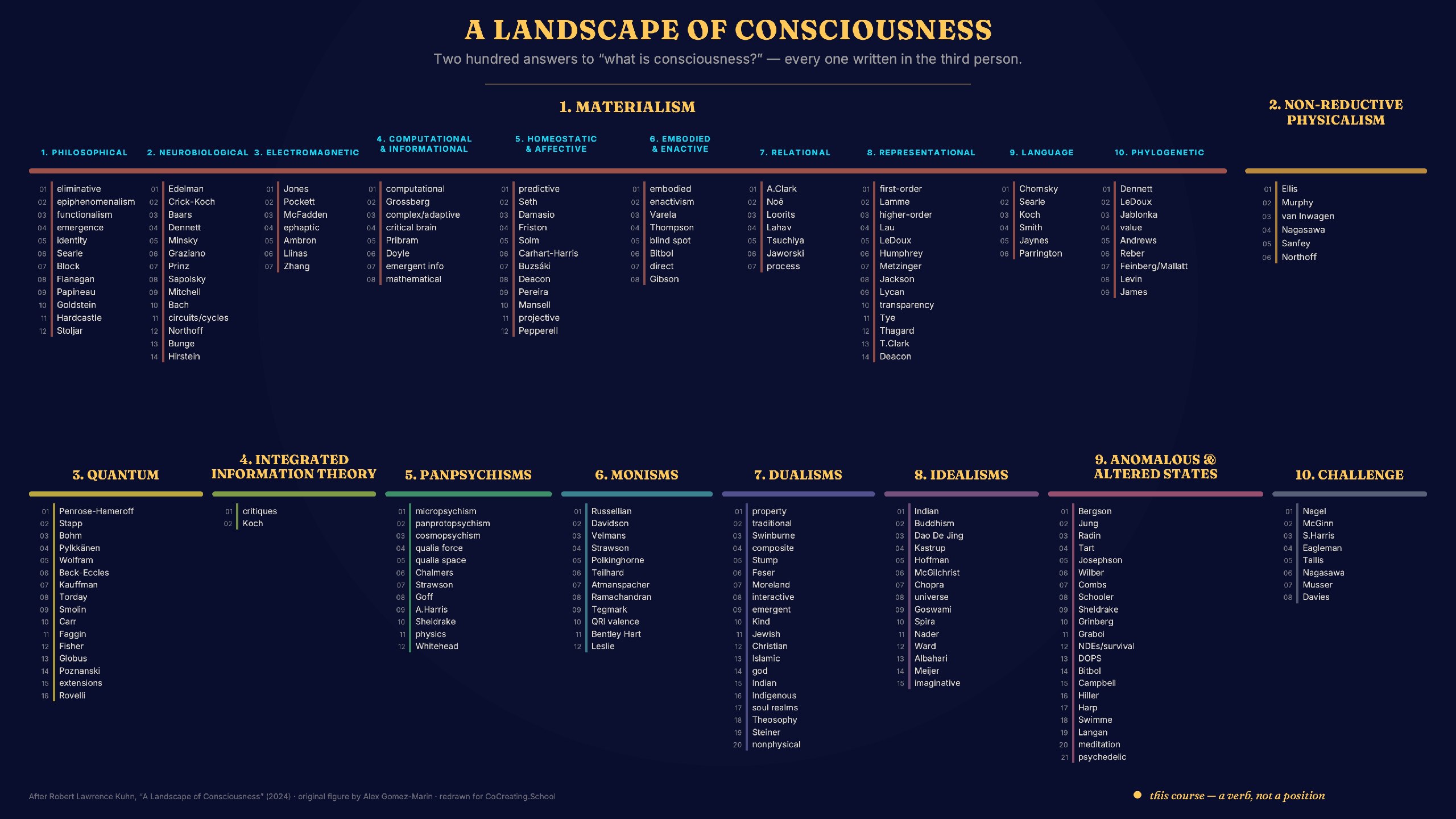
I studied it the way you study a map of a country you once lived in. And what struck me was not any single entry. It was what every entry has in common. All two hundred are written in the third person. Consciousness described from outside, as an it. An it to be explained, located, measured, defended, dissolved. Perhaps most importantly, an it to be cognitively understood.
I know that grammar from the inside, because I trained in it. I became a neurologist, and then a neuroscientist, because I wanted to know how the brain creates consciousness. I spent years mapping living brains before surgery, finding the borders of language, of movement, of memory, so a surgeon would know where not to cut. The maps were real, and they protected real function. But the more precise my maps became, the more clearly I could see what never appeared on them. The patient I spoke with the night before, the one who was afraid, the one who squeezed my hand hoping to still be herself in the morning: she was not on the scan. Circuits were on the scan. She was somewhere else entirely.
Readers of this magazine may remember what happened next in my story: a near-death experience that turned a professional question into a personal one. I will not retell it here. What matters for this essay is what it left behind. Not an answer. A grammatical suspicion. Perhaps consciousness had never been found in the third person because consciousness is not a third-person, consensus reality thing. Perhaps more importantly, consciousness cannot be explained, because explanation requires a frame; it requires definition. Now, what if the frame can only be understood not by those who studied it, but by those who actually lived and experienced it?
Philosophy has a small, honest corner that reached the same suspicion by argument alone. Thomas Nagel asked what it is like to be a bat and showed that no outside description, however complete, delivers the inside of an experience. Colin McGinn went further: our minds may be closed to this problem the way a dog’s mind is closed to arithmetic. On Kuhn’s chart these thinkers sit in their own column, politely labeled “Challenge.” I think of them as the honest cartographers of a dead end. They walked the third-person road all the way to its end and reported a dead-end street.
I believe their report. I simply read it differently. When a road ends, you can stand at its end and argue about why it shouldn’t have ended. Or you can notice that the road was pointed the wrong way, turn around, and walk back.
The move I teach in the school of consciousness is small and total: change the person of the verb. Stop asking what consciousness is. That is an it-question, and two hundred schools of brilliant people have not settled it in twenty-five centuries. Ask instead: what will you do as consciousness? That is a you-question. No laboratory can take it from you, and no philosopher can answer it for you. It is answered only by living the experience.

To work in the first person, you need exactly one assumption, which I have to state in plain daylight: the philosophy I teach assumes that consciousness is fundamental. Consciousness creates the brain and all matter, not the reverse. I have not proven this. No one has proven its opposite either. Materialism makes the mirror assumption, matter first, and has built magnificent science on top of that wager, as is its right. I claim the same right and nothing more. Two wagers, symmetric, each judged by what it lets you build.
Notice what this assumption does not demand of you. It does not ask you to leave your laboratory or your faith. A materialist can practice this philosophy without renouncing anything, because her experience remains real as experience, whatever story she tells about its substrate. So can a Buddhist, a Catholic, a skeptic. Of the two hundred positions on the landscape, this philosophy truly collides with exactly one: the corner that declares experience itself an illusion. With the other hundred and ninety-nine, it has no quarrel. Keep your belief system. I am not here to argue about them. I am here to ask what you will build with it.
An assumption is not a belief, and the difference is the whole discipline. Beliefs close questions. Assumptions open explorations. I did not stop being a scientist the day I changed my cornerstone; I brought the scientist along. When I decided to teach how to build a life from consciousness, I realized practitioners needed to be trained on three tests to continuously apply along their journey. Stability: does it hold you when life shakes? Fruits: what does it produce over time, in you, in your life, and in the people who live with you? Verifiability: can you test it in your own experience rather than in someone else’s report? An idea that fails these tests should be dropped, however beautiful its metaphysics. An idea that passes has earned its place, whichever cell of the consciousness theories chart it came from.
Experience itself needs the same discipline. In this work, every experience is a real experience. But telling revelatory experience from mundane experience is a craft, and it is the actual curriculum. Without that craft, first-person practice collapses into wishful thinking with incense. This is why I say that skepticism is not merely tolerated here. It is required equipment.
The two hundred theories will keep arguing, and I hope they never stop; it is beautiful and necessary third-person work, and one day it may even converge. But your life is not going to wait for their consensus. Beneath all the argument sits one fact that no doubt can remove, because doubting is already experience: you exist. Fundamentally. In and as consciousness. You are not a position on anyone’s chart. You are the one holding the chart.
That is why I say this philosophy is a verb, not a position. Positions are defended. Verbs are lived. They require no defending and no explaining. And the only question that was ever truly yours is conjugated in the first person. No chart will answer it. The answer has to be lived and experienced. By you.
TAKE ACTION: If you are ready to move beyond theories of consciousness and begin exploring what it means to live and create as consciousness, discover Daniel Branco’s High Consciousness Philosophy at CoCreating.School. This applied approach invites you to test ideas through your own experience, examine what they produce in your life, and develop the inner stability and discernment needed to turn consciousness from an abstract position into a lived practice.