


Trust Your Own Magic: What Oracle Cards Can Reveal About You – An Interview with Jennifer Sodini
What if the cards you pull are really a mirror of what you already know?
Most of us have had moments when a feeling, a dream, or a strange coincidence seemed to be trying to tell us something. In this conversation, Jennifer Sodini shares how her grandmother taught her to read oracle cards at eight years old, and how a long journey of hiding and then reclaiming that gift led to a life devoted to writing and intuition. Along the way, she opens up about the mystery behind her grandmother’s deck and the card reading that got her out of a ticket years later.
Whether you’ve been pulling cards for years or were once taught to fear them, this dialogue invites you to see oracle decks in a new light. Jennifer reminds us that you don’t need to be chosen or special to tap into your intuition, because the power has been with you all along.
Continue reading or listen in by subscribing for free on Spotify, Apple Podcasts, Amazon Music, or YouTube.
I’d love to hear about your journey of awakening to consciousness, mindfulness, or spirituality, whatever we might call it. Did you have religious or spiritual experiences when you were young, or did that come later in life?
Jennifer Sodini: As long as I can remember, I’ve been a deeply sensitive person. As a child, I would dream about things that later happened. I tried talking to my mother about it, but she wanted nothing to do with it.
I wasn’t raised with a religion. In fact, my grandmother, who was my mentor, actively hated Catholicism because of her own upbringing. She felt so strongly about it that she put a provision in her will stating that if any of her grandchildren attended a Catholic, cult-like, or parochial institution, she wouldn’t pay for their college education.
At the same time, she was fascinated by esoterica, spirituality, and unconventional ideas. She taught me how to read oracle cards when I was about eight years old.
Were they tarot or oracle cards? Do you remember which deck she used?
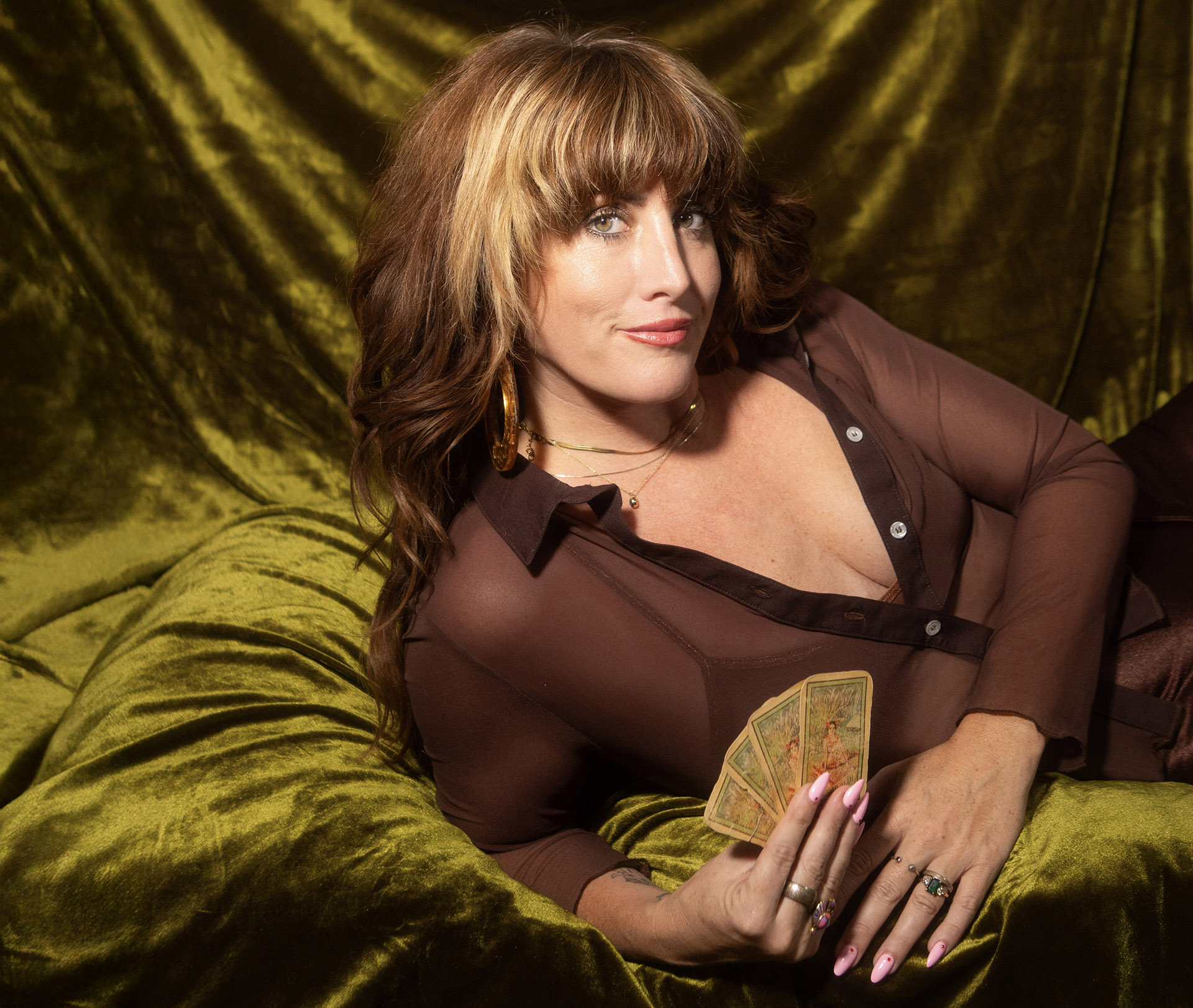
Jennifer Sodini: They were oracle cards, and I still have the deck. My grandmother died when I was 13, so I never had the opportunity to ask where the cards came from or how she found them.
I’ve had this deck for nearly my entire life and have given thousands of readings with it. It was completely unique, and for years I couldn’t identify it anywhere online. I simply thought of it as Grandma’s oracle deck.
Two years ago, a friend on social media told me, “I’m a sleuth. I’m going to find out who created this deck.” She discovered that it was called the Teuila Fortune-Telling Cards. They were created by Isobel Strong, the stepdaughter of Robert Louis Stevenson.
She developed the cards after living in Samoa, where she told fortunes at social gatherings and had connections with Samoan royalty. Discovering their history felt deeply synchronistic, almost as if there were a past-life connection. The cards truly feel magical to me.
What do the cards look like?
Jennifer Sodini: They’re very simple. Imagine a manila-colored paper background with delicate etched illustrations. One card might show a woman looking to the left, another a man looking to the right, and another a volcano in the distance.
The images are soft and understated, but together they tell a story. That fluidity is part of the difference between oracle and tarot. I often say that oracle cards are like an inkblot test for the subconscious mind, while tarot is like a blueprint of the soul moving into form.
How did your grandmother teach you to read the cards when you were eight? What was the process?
Jennifer Sodini: We would sit at her dining room table, and she would lay all the cards facedown. She asked me to choose them one by one, following my intuition, and then describe how they made me feel.
I might say, “These cards together make me feel this way, so perhaps they mean this or that.” She would respond, “Yes, Jenny, that’s right.” She was incredibly affirming.
We practiced by reading for her and for myself. Interactive storytelling taught me to trust my intuition. I have such vivid memories of sitting at her dining room table with the cards spread before us. She had a little black cat named Silk who would climb onto the table and sit with us.
What an extraordinary memory. As you grew older and entered young adulthood, what did spirituality begin to look like for you?
Jennifer Sodini: I remained a sensitive person, a deep feeler, and someone with a great deal of insight. When my grandmother died, I was 13, which is already a difficult age. You’re entering adolescence, your body is changing, and you’re beginning to understand mortality and question what life means.
Her death led me deeper into other spiritual traditions. I studied Wicca, and around that time, The Craft was released, so every millennial suddenly became interested in witchcraft. But I also explored metaphysics and Buddhism. Losing my grandmother made me want to understand what life meant.
When I entered high school, I wanted to fit in, so I hid that part of myself. After graduating, I became even more preoccupied with aesthetics and superficial pursuits.
Spirituality was always part of me, but I kept it in the closet for a long time. I didn’t want to be judged or perceived as strange. I simply wanted to fit in.
I’d also like to hear about your early experiences with writing because it’s now such an important part of who you are and what you do. Did you enjoy writing as a child?
Jennifer Sodini: I feel fortunate that my mother saved almost everything I created, including my childhood art and writing. As soon as I could write, I started writing movie reviews and short stories.
I was also an avid reader. I read Communion by Whitley Strieber when I was about 10, and I still have my original copy. That book was formative for me.
I wrote a book report on Brave New World in sixth grade. My teacher asked, “Why are you reading this?” I replied, “Why not?”
Writing and sharing my opinions have always been intrinsic to who I am. In eighth grade, I predicted I would become a movie star in foreign films while also working as a film critic.
Did your high school have a newspaper or yearbook that you participated in?
Jennifer Sodini: It did, but I didn’t like my high school. It was the kind of school you see portrayed on television, where football players and similar groups receive most of the attention. I didn’t want to be there, so I showed up, got through the day, and left. I never found it enjoyable.
I grew up in New Jersey and attended the same high school as Jack Nicholson, although a few years later.
When did you start letting spirituality back into your life?
Jennifer Sodini: It happened around 2012. I worked in pop culture and ghostwrote for a very famous reality star. While researching viral content, I came across material about the Mayan Long Count calendar and the prediction that December 21, 2012, would mark the end of the world. I wondered, “What is this?”
That research led me to the work of Terence McKenna and Alan Watts. Then I discovered the documentary 2012: Time for Change, based in part on Daniel Pinchbeck’s work.
When I watched it, I thought, “This is exactly what I’m feeling.” It reawakened everything I had buried, including all those feelings, ideas, and hidden parts of myself.
At the time, I was living almost like a housewife while working for a pop-culture blog. I wasn’t married, but I felt trapped in a golden cage. I began asking, “What has my life become? This isn’t who I am. This isn’t who I used to be.”
It reminded me of the Talking Heads lyric, “This is not my beautiful house. This is not my beautiful life. How did I get here?”
That documentary became a catalyst that completely changed my life. It led to a series of synchronicities and events that prompted me to end my relationship, travel to Costa Rica, and experience ayahuasca for the first time with Daniel Pinchbeck.
That summer, I created my blog, Evolve + Ascend. The process wasn’t about becoming something new. It was about releasing everything I wasn’t.
How did your life change when you returned from Costa Rica? What did you do as a result of those experiences?
Jennifer Sodini: When I returned from Costa Rica, I owned 16 Bitcoin, which felt significant in the summer of 2013. I thought, “This is what I’ll invest in the rest of my life.”
I felt so certain about the messages I had received through the medicine and this reawakening that I believed my life would be mapped out for me. Then, that same summer, a major hack and scam stole my Bitcoin.
Until then, I had never really experienced financial hardship or understood what it meant to survive entirely on my own. The experience reminded me of a Terence McKenna idea: when you reach the abyss and jump, you may eventually discover that it is a feather bed, but first you must take the leap of faith.
I had nothing else I wanted to do with my life and no backup plan. I decided to put everything I had into making the new path work.
I poured my heart into the blog while bartending, reading cards, taking odd jobs, and hustling in every way I could. Gradually, everything began falling into place.
It was an initiation into the life I know now, but it required tremendous trust because I began with nothing.
Many people can relate to reaching a turning point through a relationship ending, bankruptcy, a career change, or some other form of rock bottom.
Jennifer Sodini: Mine happened during my Saturn return. As esoteric as I am, I had never given astrology too much authority. But the Saturn return felt very real for me.
It was as though time was going to devour everything I thought I knew about myself.
You were already giving readings, but what inspired you to create your first oracle deck? How did that process begin?
Jennifer Sodini: Because I had my grandmother’s deck throughout my life, reading cards became my party trick in high school. Even while hiding that part of myself, I still gave readings to friends.
Once, at a high school party, I read for a football player. I told him, “I see you joining the Navy and perhaps becoming a police officer.” It was an unusually specific reading, and I remembered it vividly.
Years later, around the time I began offering readings publicly, I was talking on my phone while driving and was pulled over by a police officer. When I looked up, it was the same person I had read for in high school.
He said, “Jen.”
I replied, “Oh my God, you did it, didn’t you?”
He told me that he had joined the Navy and never forgotten my reading. Then he let me go without a ticket. It was a remarkable full-circle moment.
In the summer of 2014, I began offering public oracle readings as a potential career. I worked at an incredible Jersey Shore shop called Paranormal Books & Curiosities. My partner at the time was a tour manager for several well-known bands, so I also read cards for musicians and had some extraordinary experiences.
Eventually, I felt as though an angel had touched me. I received a strong message connected to my past, telling me that my path was about teaching. My writing was meant to help people understand that we’re all capable of accessing intuition.
I realized I needed to stop offering public readings, so I closed that part of my practice. I deeply respect readers who maintain strong boundaries, but I didn’t do that well. Many of my clients became my friends, and I found myself wanting to say, “I can’t change what the cards are showing. This may be something you would benefit from exploring in therapy.”
I decided to focus more deeply on writing. Three years later, I was scrolling through Instagram when I encountered the work of an artist named Natalee Miller.
Her art awakened something in my heart. It felt like seeing an object in a museum and suddenly remembering it.
I reached out and said, “I’ve wanted to create an oracle deck for a long time. I grew up reading oracle cards, and they’ve been an important part of my path. Your artwork is so beautiful. I don’t have a firm plan and may self-publish, but would you like to collaborate?”
We spoke on the phone, and it felt like meeting a soulmate. From there, everything started to fall into place.
At the time, I was conducting many interviews for my former podcast, Liberation Frequency. I was also working with Watkins Books, which sent authors to me for interviews. We had developed a wonderful relationship.
I contacted someone I knew there and said, “I want to create an oracle deck. Would Watkins be interested in publishing it?”
I’ll never forget his response because it was incredibly generous. He said, “As much as we would love to publish this, you need a literary agent because you can probably secure a major publishing deal. I don’t want you to sell yourself short.”
Through a good friend, I found a literary agent. Within a couple of weeks, we had a major publishing deal, and the rest is history.
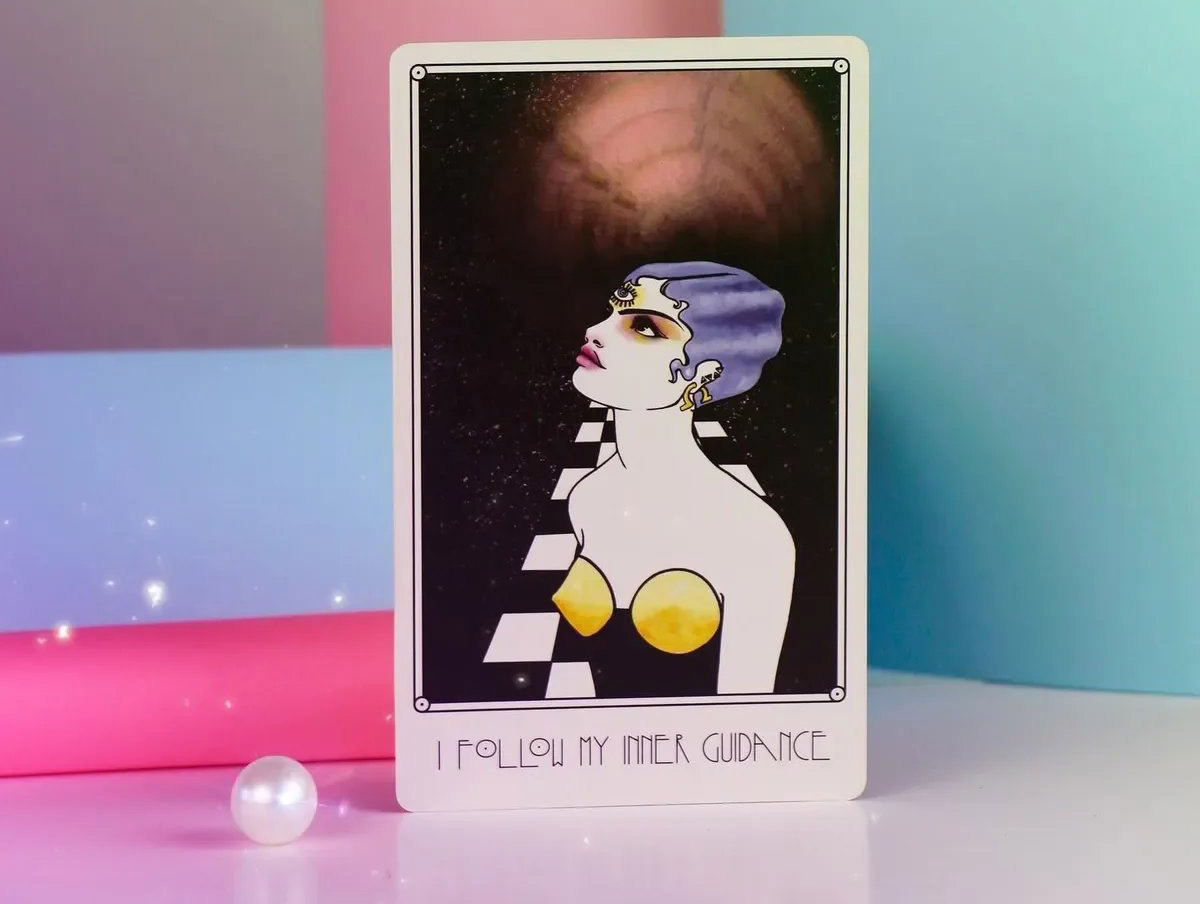
Ameniti Oracle Deck.
When was your first deck released?
Jennifer Sodini: My first deck, Amenti Oracle: Feather Heart Deck and Guide Book, was released in 2019.
Please describe the imagery and share what you find so compelling about it.
Jennifer Sodini: The deck’s subtitle is Ancient Wisdom for the Modern World, and its central concept is living with a feather-light heart. It draws on the 42 ideals of Ma’at, the ancient Egyptian principle and goddess of truth, justice, and balance.
Ma’at is traditionally depicted with an ostrich feather on her head. In the Egyptian funerary tradition, the heart of the deceased is weighed against her feather. If the heart is as light as the feather, the soul can continue into the next life.
The deck presents 42 principles for living in alignment with a feather-light heart. They include affirmations such as “I can be trusted,” “I honor virtue,” and “I live in truth.”
I love a substantial guidebook, so I wrote one that can almost stand alone. You can pull a card as an affirmation or use the cards for a reading, then turn to the guidebook and explore the message more deeply.
What I love about Natalee’s art is its nostalgic feel. It reminds me of avant-garde imagery from the 1990s while also carrying an influence of Japanese manga. It feels completely distinct.
Part of my motivation for creating an oracle deck was that much of the imagery available at the time felt stale to me. With blessings and respect to Doreen Virtue, that visual style simply wasn’t my aesthetic. I wanted to create something edgier.
Walk me through the process of creating an oracle deck. We recently released one for the Awakened Lifestyle Expo, and at least 10 people have already asked where we had it printed. Many people seem drawn to creating decks, especially now that technology has made the process more accessible, although an influx of AI-generated oracle cards may not necessarily be a good thing.
What was your creative process like? Did you develop the concept and then have Natalee create the artwork, or did the two of you shape it together?
Jennifer Sodini: It was a little of both. Natalee and I have a very unique connection. She is one of my great soulmates in this life.
As an artist, an Aries, an only child, and someone from New Jersey, I don’t like being told what to do, and I definitely don’t like being micromanaged. But I trusted her implicitly.
I told her, “This is the idea and the foundation. I would love to write the cards, and I want you to draw whatever they make you feel.”
The process was wild: I would write something with a particular image in mind, and she would draw what I had been imagining. We trusted each other completely and let ourselves stay in that creative flow.
We were constantly calling each other and shouting, “What? How did this happen? I can’t believe this synchronicity!” I realize that kind of connection doesn’t exist in every collaboration.
I’ve worked with other collaborators where the process is much more formal and professional. You need to prepare a creative brief, explain exactly what you want, and establish clear boundaries. Working with Natalee feels more like a psychic ceremony.
Did you give her only the words that would appear on each card, or did you also write the corresponding guidebook passage before she created the artwork?
Jennifer Sodini: I wrote the full guidebook passage first. For example, one of the cards is “I Honor Animals with Reverence.” I wrote a full passage exploring that affirmation, and Natalee created the artwork based on the complete text rather than just the short phrase.
Did Natalee also handle the graphic design and assemble the deck before you worked with the publisher? Which publisher did you choose?
Jennifer Sodini: We worked with RP Mystic, which is part of Running Press and Hachette Book Group. Our deck helped launch the RP Mystic division.
At the time, The Wild Unknown had become incredibly popular. It’s a gorgeous deck, and the publisher saw Amenti Oracle as a title that could help similarly launch their division.
They were incredible to work with. I was initially worried because I’m unusual and tend to have big ideas. When I submitted the manuscript, I thought, “Shannon is going to return this with so many edits.” But most of the changes involved only grammar and syntax.
The entire experience was wonderful. I’ve published all but one of my decks through Running Press, and they’ve been incredible champions of my work. Their editors, designers, and quality-control teams have all been excellent.
When you develop a new idea, do you take it directly to Running Press and ask whether they’re interested? How does that process work?
Jennifer Sodini: After Amenti Oracle, the process changed because I had a literary agent. I’ve been very fortunate to connect with wonderful women, and my agent is an essential part of my dream team.
Every idea I have, and I have many, goes through her first. She serves as my barometer. If she says, “Yes, move forward with this,” I know the idea is strong. If it isn’t ready, she tells me no.
Once she approves the concept, we create a proposal and bring it to Running Press or another potential publisher. Running Press is my primary publisher, but that is the general process.
For example, I created the Be Not Afraid deck with Natalee based on the celestial hierarchy and biblically accurate angels. I had wanted to make that deck for a long time.
I presented the idea to my agent, and she loved it. I developed the proposal, Natalee created several sample cards, and Running Press embraced the concept. Two years later, they released the deck.
When publishers consider a deck proposal, what are they looking for?
Jennifer Sodini: Technology has made self-publishing more accessible, but a traditional publisher needs to see commercial potential. They want to know whether you have a platform and a marketing engine. They also want to understand why you are the perfect person to create this particular work and whether anyone else could communicate the idea as effectively.
They’re asking, “Why you? What will make this deck stand out in a market that is already oversaturated?”
Almost everyone has an idea for a tarot or oracle deck. A publisher wants to identify what makes your concept special and determine how they can sell it.
You’ve worked with a publisher on all six of your decks rather than self-publishing them, correct?
Jennifer Sodini: Yes. The only project I self-published was the first thing I ever created, a small children’s book about cosmic consciousness. We don’t need to talk about that one.
What are the advantages and disadvantages of traditional publishing versus self-publishing an oracle deck?
Jennifer Sodini: Traditional publishing is brutal, competitive, and extremely difficult. Even securing a literary agent is challenging. Agents’ inboxes are flooded with queries, and they accept very few writers, especially if you don’t have a warm introduction.
Finding an agent is the first hurdle. The next is securing a publishing deal. Publishers want to know how the project will sell and what kind of audience it can reach.
Publishers are also recognizing that influence doesn’t necessarily translate into sales. You may have 100,000 followers or more, but will those people buy your books? Are they genuinely invested in your work, or are they following you for memes? A publisher will examine that carefully.
Once you overcome those hurdles, one benefit of traditional publishing is the advance. Typically, you receive part of the advance when you sign the contract and the remainder when you deliver the final materials. From that amount, you subtract your agent’s 15 percent commission and taxes.
It can feel like a substantial amount of money, but you may spend a year working on the project. When you calculate the number of hours involved, the advance may not seem as large as it initially did.
Another major benefit is distribution. Your work can reach physical bookstores and a variety of retail outlets. You also gain access to a professional team of designers, editors, production specialists, and quality-control experts who help make the final product polished and cohesive.
Even with a publisher and an in-house publicity team, however, much of the marketing will still fall on you. The author remains the primary promotional engine behind the book or deck.
In an ideal situation, you also have an agent who understands foreign rights and maintains relationships with agents in countries such as France, Germany, and Italy. Once a publisher has acquired your deck, your agent may be able to license it in other territories.
The international advances may be smaller, perhaps $3,000 or $5,000, but those editions allow your work to reach a global audience.

Be Not Afraid Deck.
Could you see yourself self-publishing a deck in the future?
Jennifer Sodini: I love working with Running Press and hope we have a long relationship. If I self-publish anything, it may be fiction.
I’ve been exploring fiction since 2023, and that is an entirely different world. It’s also very difficult. But you heard it here first: I may explore self-publishing my fiction.
Earlier, you beautifully described the difference between tarot and oracle cards. Do you also read tarot?
Jennifer Sodini: I do, and I enjoy tarot. A tarot reading feels like a therapy session because it offers a broader picture of what you need to explore. It can illuminate your thoughts, actions, emotions, finances, and the archetypal forces at work in your life.
I usually turn to tarot when I need a deep dive. Pulling an oracle card feels lighter. It offers a simple message that can guide me through the day.
My latest deck is called Feline Mystique. It’s a sweet, playful oracle deck centered on cats.
Does Natalee also illustrate this deck?
Jennifer Sodini: No, this one is illustrated by Amelia Rose. She’s a tattoo artist as well as an incredible illustrator and designer, and she was a wonderful collaborator.
Working with Natalee feels ceremonial and psychic. Together, we descend into the underworld and travel all the way into the astral realms. With Feline Mystique, I wanted to create something sweet, playful, and whimsical.
Amelia made that process effortless. I could give her an idea and trust her to understand it. For example, the cover is loosely inspired by Puss in Boots, but I told her I wanted it to feel like Kinky Boots.
The deck explores different cat breeds through pop culture, playfulness, and whimsy. If I pull a card during my daily practice, I receive a clear message for the day. I might pull “Resilience” and decide to embody that quality. Or, if it’s Friday, I might pull “Euphoria” and take it as a reminder to have fun.
The guidebook was especially enjoyable to write. For Dungeons & Dragons fans, we placed every cat on an alignment chart, ranging from chaotic to spicy to neutral.
The experience is almost like a gentle choose-your-own-adventure game. It’s a very sweet deck. If you love cats, it doesn’t matter where you fall on the spiritual spectrum. There is something in it for you.
I grew up in a very conservative Christian environment and spent 10 years as a pastor. Until about five years ago, I didn’t even know the difference between tarot and oracle cards. My partner, Mandy, probably owns 100 tarot decks, and we have many oracle decks around the house.
I’ve only had a few tarot readings, and I’m personally more drawn to oracle cards. Perhaps they feel more accessible because I haven’t studied or memorized the meanings of the tarot cards. That represents an extraordinary transition for me because I was taught that tarot and oracle cards were unquestionably demonic and frightening.
Now I find them fascinating, especially because oracle decks can approach life from so many different perspectives. We even created one for Awakened Magazine, and I’m interested in making more. I love their beauty, physicality, and tactile nature. Over the years, have you met people carrying fears similar to mine?
Jennifer Sodini: I’ve encountered the entire spectrum. Some people are eager to dive in, while others carry significant fear and religious conditioning.
Just yesterday, I connected with a lovely person who is working through religious trauma and freeing herself from the belief that practices like these are demonic, sorcerous, or merely a form of fortune-telling. We had a long conversation about it.
I often point out that many religious writings, especially apocryphal texts, describe the prophet’s role as sacred. I believe much of that understanding was lost in translation or distorted by systems of control that interfered with the original messages of figures such as Jesus, Muhammad, and Buddha.
Buddhism isn’t opposed to oracles. In fact, active oracle traditions exist within Buddhism. For many people, the process involves reexamining their programming and understanding that intuition isn’t demonic or sorcerous.
Intuition is an inherent human capacity. Cards are simply a medium that can help us access the part of the mind that receives those messages.
I didn’t grow up with that religious conditioning, but I remember attending church with friends after sleepovers. I had never been baptized, and my friends would tell me, “You’re going to purgatory.”
I would ask, “Why? I’m kind, I’m nice, and I’m a good person. Am I going to be punished because I didn’t participate in a water ritual?”
When you say some of these beliefs aloud, you begin to question them. I understand that there is an entire world of religiosity and programming behind those ideas, but do we truly believe that a loving God would send someone to hell because water wasn’t poured or splashed over them?
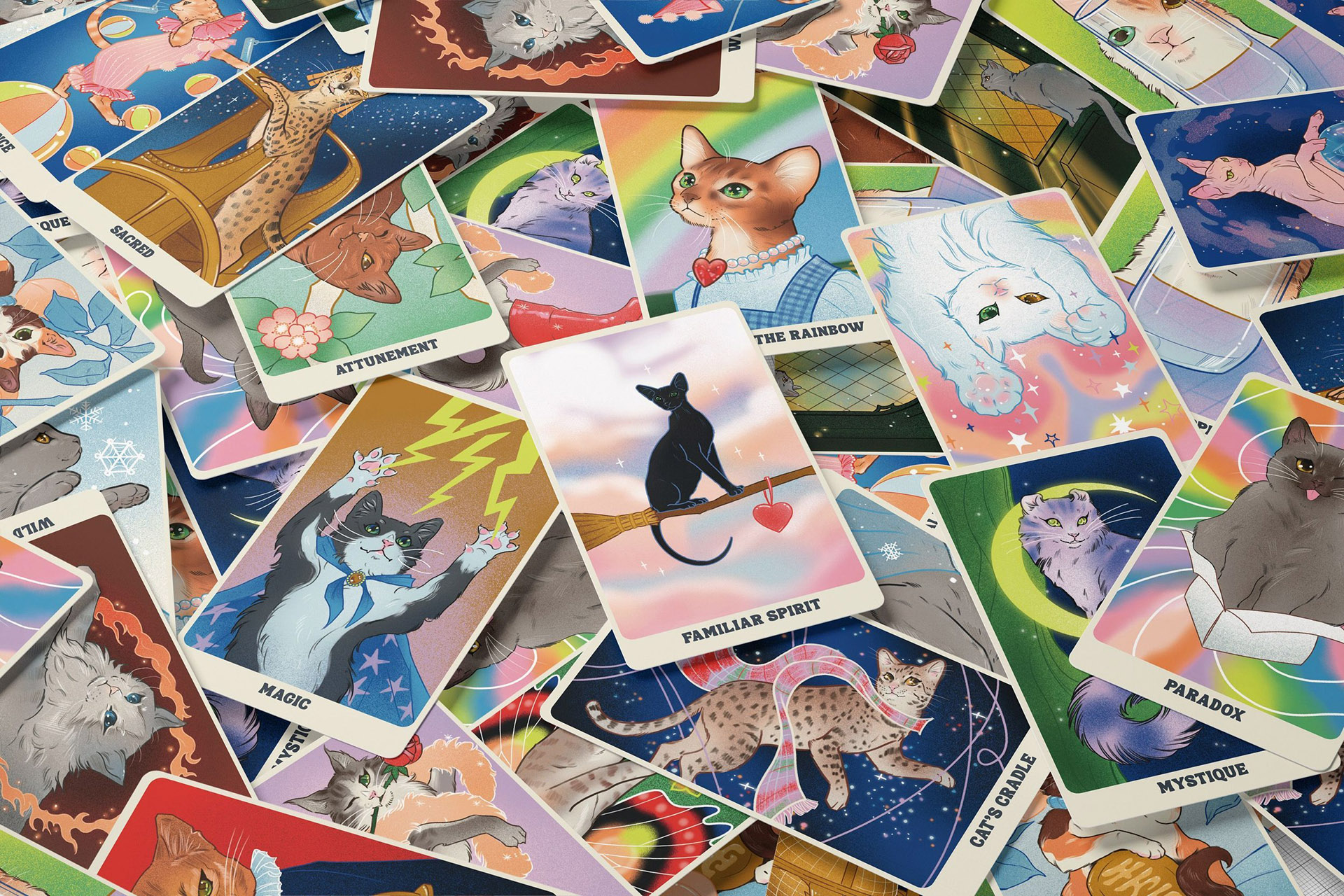
Feline Mystique Oracle Deck.
When someone purchases one of your decks and begins working with it, what do you hope they experience?
Jennifer Sodini: My greatest hope is to evoke a feeling of joy and possibility: “Wow, I can do this.”
I always return to The Wizard of Oz because I love the message that the power has been within you all along. Pay no attention to the man behind the curtain. You already have the power.
I want to instill a sense of autonomy and hope. I want people to realize, “Holy crap, I’m an intuitive being. I can do this on my own, and these tools can help me access that part of myself.”
I also want to help people see the world differently. I love pop culture, and I enjoy incorporating it into esoterica and developing an entire system of language around it.
You don’t have to be a witch. I actually loathe that word. You don’t have to be specially selected or chosen.
You’re a human being. You have an imagination and intuition; you dream, and you have agency over your life. Tap into that part of yourself. You don’t need to become someone special because you already are special.
You have a four-and-a-half-year-old daughter. How has the life you’ve created influenced the way you’re raising her? We make so many parenting decisions, either intentionally or by default. How has everything we’ve discussed shaped your approach?
Jennifer Sodini: It has influenced everything. I was never certain whether I wanted children. I’ve always connected well with them because I’m like a Muppet of a person, and I love kids. But I’m also very independent, so I wasn’t sure motherhood was for me.
Having my daughter changed everything. She helped me recognize how precious the soul is and how precious this human life is.
I’m not here to control her. I’m here to guide her, serve as a custodian of her life, and help set her on the right course.
That intention shows up in small ways, like getting down to her level when I speak with her and asking questions rather than simply giving instructions. Every morning, I ask whether she had any dreams the night before.
We talk very openly about life. She’s reached the age when she’s beginning to ask about death, and I try to meet those questions with openness. I encourage her to use her imagination and creativity.
We watch movies as a treat, but she doesn’t spend time on an iPad or other personal devices. Instead, I expose her to mythology and different ways of seeing the world.
One of our favorite subjects is the Japanese world of spirits known as yōkai. We read a yōkai book together, talk and laugh about the different beings, and then she invents and draws her own. They’re often funny and silly. Creatures from franchises such as Pokémon draw inspiration from that world.
Motherhood has allowed me to see the world through her eyes. I don’t treat her as though she’s less than me. I see her as a little person I can have big conversations with, and I gently help her navigate them. It has been incredible.
Have you done oracle readings with her?
Jennifer Sodini: She loves the cat deck. She’ll choose a card, and we’ll talk about it together.
When Feline Mystique was released, I asked which card she thought represented her. She selected “Persnickety,” which features a cat in a bathtub, and said, “This is me, Mama.”
Something similar happened with Be Not Afraid. Natalee and I used our usual psychic, ceremonial process while working with angelic imagery, and she designed the cover. When I saw it, I said, “I think you drew Viv. This looks so much like my daughter.”
Now, whenever my daughter sees the deck, she says, “It’s me!”
What hopes and dreams do you have for the future? Are there things you think, “One day, I want to do that,” or are you more focused on living in the moment?
Jennifer Sodini: It’s a little of both. Over the past few years, I’ve focused on finding my footing in the world of fiction.
Movies and pop culture were my first loves, and that is ultimately where I want my career to go. I want to tell bigger stories and weave archetypal wisdom into fictional worlds. Sometimes it’s much easier to hide the truth in fiction.
I’ve completed two novels, and one is currently on submission. They inhabit very different worlds, but my writing tends to fall within upmarket speculative fiction, horror, and dark comedy.
I’ve also been taking a screenwriting course, and I’m about two weeks away from completing my first screenplay. My greatest goal is to create films and books that explore these subjects through an approach that feels like the A24 of esoterica.
How do you structure your daily life? You have a young daughter, a partner, your work with Hidden Hand Media, your fiction, and your oracle decks. How do you manage all of it?
Jennifer Sodini: Honestly, I don’t even know. One of my best friends used to watch me work and say that I operated like a multi-armed deity.
I have 10 million tabs open. I’m taking a call, writing an email, and doing several other things at once. I think the lack of a system is my system.
I’m constantly trying to remain in a state of flow with my work. I don’t want to force things or overmarket them. The way I approach everything may seem insane to someone else, but it works for me.
I’m not sure how I balance it all, and sometimes it’s very difficult. Before we started recording, I mentioned that I’ve been moving through a particularly stressful period with client work. When that happens, I become unbalanced. It’s a work in progress.
When do you do your best fiction writing? Is it early in the morning or late at night?
Jennifer Sodini: I write when the muse arrives. I’m very much a sunshine person, perhaps because I’m an Aries and have that fire within me, so I generally prefer writing in the morning.
Sometimes, however, an idea takes hold and time dissolves. Suddenly, it’s two in the morning, and I think, “Okay, here we are.”
What kinds of clients do you work with through Hidden Hand Media?
Jennifer Sodini: Through Hidden Hand Media, I work with thought leaders, bestselling authors, and business professionals who have already scaled their work and are looking for additional support with organic marketing.
I also help people with a strong book idea who need guidance through the publishing process. That may include developing the initial concept, creating a pitch, querying literary agents, or providing ghostwriting support.
I’m very transparent with potential clients and have turned down projects because publishing is so subjective. I don’t like taking on a client who believes, “Jennifer is going to get me a major publishing deal,” only to invest tremendous time and money without that result.
Every publishing project involves risk, but I prefer working on projects where I feel confident about the likelihood of success. Their success is my success.
If someone hopes to create an oracle deck and is beginning to explore ideas, what advice or encouragement would you offer?
Jennifer Sodini: Follow your heart, and don’t overthink it.
Social media and its algorithms can make us obsess over what other people are doing. We think, “They’re doing it this way, and they’re doing it better. How do they have hundreds of thousands of followers? Maybe I should do what they’re doing. Shadow-work journals are popular right now, so perhaps I should make one of those.”
Remove all of that from your mind. Ask what makes you happiest in your heart of hearts and what you truly want to create. Then follow that path.
That is the path of least resistance, and it’s where your best work will emerge. You will still need comparative titles to demonstrate how and where the project can sell, but trust that you have something unique to say.
Don’t become overwhelmed by what everyone else is doing. You may have something extraordinary to offer that no one else is saying, and you may be the person who needs to say it.
I’ve noticed on social media that you enjoy thrift stores. You’re always posting unusual finds that make me wonder, “Where did she discover that?”
Jennifer Sodini: I call it “thriftomancy,” the ancient art of thrift-romancy.
We love estate sales, Goodwill, and secondhand shopping. I found the shirt I’m wearing at the Goodwill in Hollywood. It’s fascinating because these stores can almost reflect the subconscious mind.
One of my novels contains certain recurring themes involving a song, a book, and even an umbrella. Then I’ll visit a thrift store and suddenly find the exact record I’ve just written about.
Recently, after finishing a major project, I went to a thrift store and found books by three people featured in the manuscript. I thought, “Thank you for the cosmic affirmations, Goodwill.”
Secondhand shopping is also an opportunity to recycle and upcycle rather than participating as heavily in fast fashion.
I used to visit many estate sales. At first, I found it unsettling to look through the clothes and possessions of someone who had died. But once I moved beyond that feeling, I found the experience fascinating. You see extraordinary homes, many of them beautifully retro, and receive a glimpse into another person’s world. I relate deeply to the images you share.
Jennifer Sodini: Thank you. One of the last estate sales I attended genuinely surprised me.
Estate sales can be wonderful for writers, artists, and anyone experiencing a creative block. They pull you out of your head and let you study an individual life through the objects someone collected and how they lived.
At this particular sale, the person had an extraordinary collection of books covering Americana, world history, esoterica, and Qumran. There were also many books by Arthur C. Clarke.
At the same time, this person loved guns and Fabergé eggs. Then I discovered a collection of at least 30 copies of The Wind in the Willows.
There was something strange, endearing, and deeply human about that combination. This person studied Americana, world history, guns, and esoteric subjects, yet also adored the story of Mr. Toad and his friends.
I found myself wondering, “Who were you?”
Where can people find your oracle decks, writing, and work with Hidden Hand Media? What is the best way to connect with you?
Jennifer Sodini: You can find me on Instagram under Jennifer Sodini. My website is JenniferSodini.com, and you can also find my writing on Substack.
You can learn more about my client work at HiddenHandMedia.com. My oracle decks are available through most major retailers.
Amazon purchases help our rankings, even though we may not want to give Jeff Bezos much more money. You can also find all my current titles through my Hachette Book Group author page.
Jennifer, it has been wonderful spending this time with you. Thank you for helping people awaken in such a creative and beautiful way.
Jennifer Sodini: Thank you for everything you do and for who you are. This was so much fun.


